If there’s one local character I would have loved to sit down with and share a bottle of wine, it would have been Walter Taylor. Truth be told, I’m much more of a coffee gal—but for an evening with Mr. Taylor, I’d gladly make an exception. I imagine uncorking a bottle, settling in, and simply listening as he told the stories only he could tell.
In the late 1970s and throughout the 1980s, Walter became something of a wandering evangelist for Finger Lakes wine — traveling the country in farmer overalls and a cowboy hat, talking about Keuka Lake and the future of New York wine. He seemed to be everywhere at once — in newspapers, on television talk shows, and speaking to wine audiences across the country — always carrying the story of this small lake and its vineyards far beyond the hills of Yates and Steuben Counties.
His story would become one of the most dramatic chapters in the history of wine around Keuka Lake.
Walter was born into one of the region’s most famous wine families. The Taylor Wine Company, founded in 1880 in Hammondsport, had grown into one of the largest wineries in the country. But Walter was never one to quietly follow tradition.
He spoke openly — sometimes loudly — about what he believed New York winemaking should be. He criticized the use of imported California grapes in wines labeled as New York products, once joking to an audience of wine executives in San Francisco that the water level in Keuka Lake dropped several inches every bottling season.
Not everyone appreciated his humor.
The board of directors at Taylor Wine — many of them relatives — eventually gave him an ultimatum: resign or be fired.
Walter chose to be fired.
He moved up the hill to Bully Hill, the original home of Taylor Wine, where a small experimental winery had been set up to test grapes that could survive the harsh Finger Lakes winters. Using salvaged tanks and secondhand equipment, Walter turned that research facility into Bully Hill Vineyards.
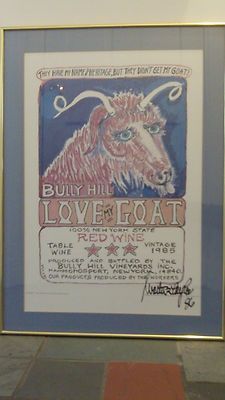
There he championed hybrid grapes designed to withstand the region’s brutal winters. His wines carried names as colorful as the man himself — Old Trawler White, Meat Market Red, and Le Grande Blush — and the labels, many drawn by Walter personally, were filled with humor, wit, and rebellion.
Then the real fight began.
In 1977, Coca-Cola purchased the Taylor Wine Company and soon went to court to prevent Walter from using the Taylor name in connection with his wines. The court agreed.
Walter could no longer use his own last name.
Most people might have quietly complied. Walter turned the moment into theater.
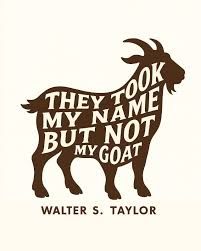
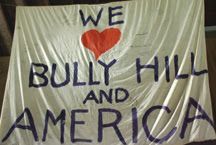
At one famous rally, nearly 200 supporters gathered as Walter literally inked his own name off hundreds of Bully Hill wine bottles. His labels soon carried new images and messages poking fun at the legal battle. One featured a stubborn goat with the line:
“They have my name and my heritage… but they didn’t get my goat.”
Another pictured Walter as the Lone Ranger with the caption, “Who was that masked man?” Bumper stickers appeared reading:
“Enjoy Bully Hill — the un-Taylor.”
Even when the courts ordered him to turn over the offending materials, Walter did it in classic fashion — delivering them to Coca-Cola in a manure spreader, a moment that instantly became local legend.
But wine was only one of Walter’s passions.
He loved art, music, and aviation, and he took great pride in Hammondsport’s connection to aviation pioneer Glenn Curtiss. Walter helped gather historical aircraft memorabilia that would later become part of the Curtiss Museum.
He also designed many of the iconic Bully Hill labels himself — whimsical drawings that today have become collectors’ items. At one point he even served as an official artist for NASA, painting the Space Shuttle Columbia in 1982.
Walter’s imagination could wander far beyond the vineyards. After a trip to Europe, he became convinced that sheep manure was the perfect fertilizer for vineyards. He persuaded his father to purchase a nearby farm and even imported a Scottish shepherd to tend the flock.
Legend has it that one day the prized ram — a one-eyed sheep named Thor — escaped his pen and enthusiastically visited the entire flock before collapsing from exhaustion. When Walter’s father exploded in disbelief at the loss of the valuable animal,
Walter calmly replied:
“Well, Dad… at least poor old Thor died with a smile on his face.”
Even Greyton Taylor had to laugh.
Later in life, as Bully Hill grew into one of the most recognizable wineries in New York State, Walter spent more time painting and sketching. For a while he even slung a guitar across his back and hitchhiked across the country, drawing the places and people he encountered along the way.
Though the wine industry eventually moved toward European grape varieties championed by pioneers like Dr. Konstantin Frank, Walter’s outspoken defense of Finger Lakes grapes helped push the region’s wine conversation forward during a critical time.
In January 1990, while traveling near Tampa, Walter’s van was struck from behind by a truck, leaving him paralyzed. He passed away in April 2001 at the age of 69.
But around Keuka Lake, Walter Taylor’s spirit still lingers.
Because every now and then, a place produces someone who refuses to follow the script… someone who argues loudly, dreams boldly, and leaves behind stories people will tell for generations.
Walter Taylor was one of those people.
And if you ever find yourself sitting on the deck at Bully Hill, looking out over Keuka Lake with a glass of wine in your hand, it’s not hard to imagine him there somewhere — smiling quietly, stubborn as ever, knowing that while others may have taken his name…
but they never did get his goat.
Stay Rooted. Stay Keuka. 🌿