There are people who look at an empty field and see exactly that.
An empty field.
Glenn Hammond Curtiss rarely seemed to see the world that way.
He saw what could be.
Give him a bicycle, and he wondered how to make it faster.
Give him an engine, and he imagined what else it might power.
Give him an airplane, and he began thinking about how it could take off from water.
And years later, give him thousands of acres of undeveloped Florida land...
And Glenn Curtiss began imagining cities.
That may be one of the most fascinating things about the young man who grew up in Hammondsport.
Curtiss wasn't simply an inventor.
He was an entrepreneur.
His remarkable mind could take creativity and turn it into a plan—and then take that plan and figure out how to make other people believe in it, too.
And one extraordinary day in Hialeah, Florida, shows us exactly how that mind worked.
He Never Saw Just One Possibility
By the early 1920s, Glenn Curtiss had already accomplished enough for several lifetimes.
The former Hammondsport bicycle mechanic had raced motorcycles, built engines, designed airplanes, pioneered flying boats, trained early naval aviators, and helped transform aviation from an experiment into an industry.
But Curtiss wasn't finished creating.
His attention turned south to Florida, where he partnered with businessman and cattleman James H. Bright.
Together, they controlled vast stretches of land west of Miami.
Where others might have seen ranchland, Curtiss saw communities.
He envisioned roads, homes, parks, canals, airfields and neighborhoods.
But imagination alone doesn't build a city.
People had to come.
They had to see the land.
And most importantly, they had to believe in what it could become.
That presented an interesting business problem.
And Glenn Curtiss found a very Glenn Curtiss solution.
He brought in the airplanes.
Don't Just Advertise the Dream. Let People Experience It.
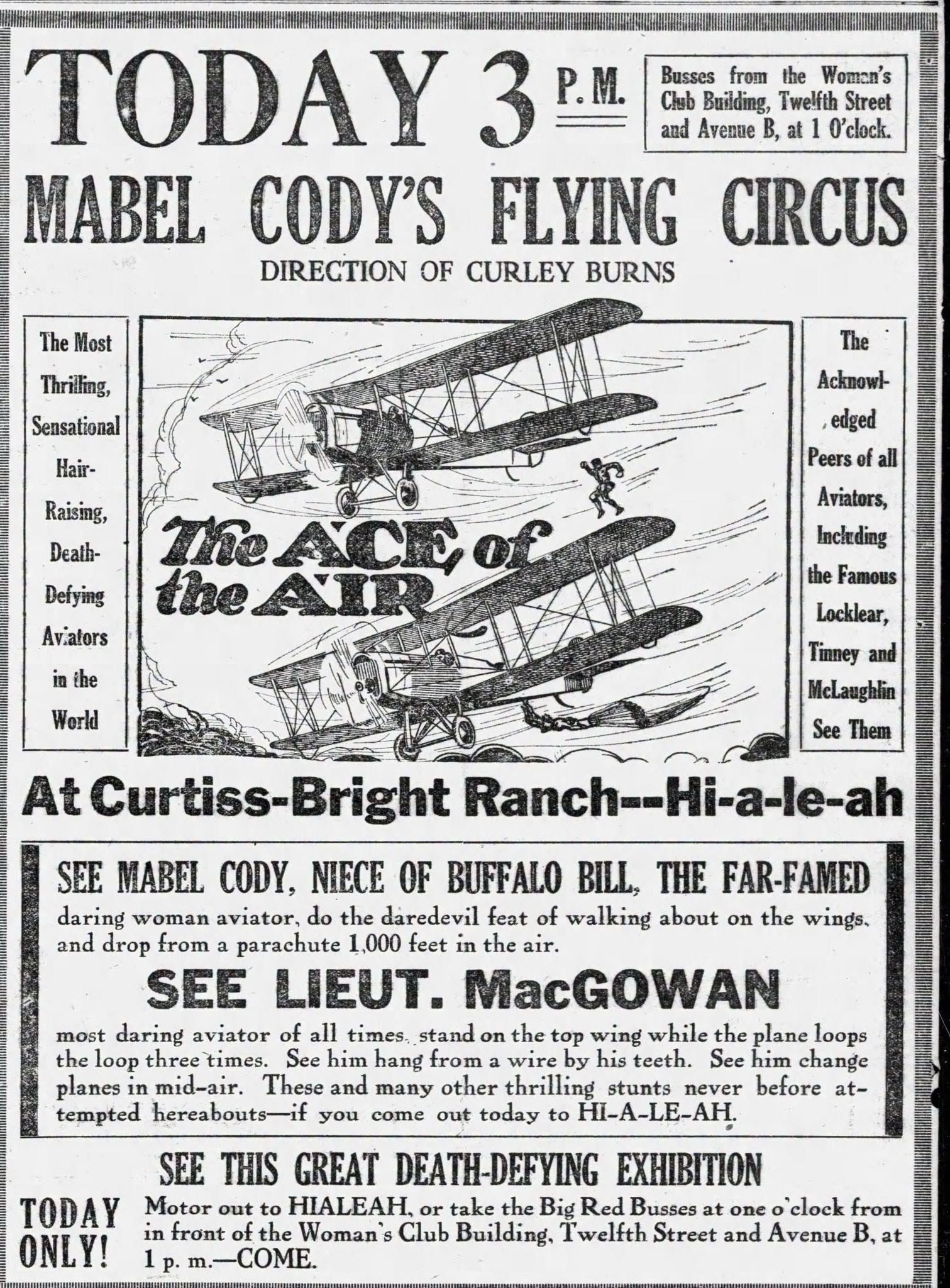
On March 27, 1921, the Curtiss-Bright Ranch became the setting for a massive flying exhibition promoted as Mabel Cody's Flying Circus.
Think about the brilliance of the idea.
Curtiss had something he wanted people to see: land.
But instead of simply placing an advertisement saying LOTS FOR SALE, he created a reason for thousands of people to travel there.
The promotion promised an afternoon filled with aerial excitement—wing walking, loops, parachute jumps, mid-air transfers and other daring feats.
Nearly 6,000 people reportedly came.
They may have arrived to watch airplanes.
But once they were there, they were standing in the middle of Curtiss and Bright's future development.
That was the entrepreneurial genius of Glenn Curtiss.
The aviation pioneer and the developer weren't two different people.
They were the same creative mind at work.
Curtiss took something he already understood extraordinarily well—aviation—and used it to solve an entirely different challenge: how do you get people excited about undeveloped land?
He created an experience.
The Flying Circus Was Only Part of the Plan
The featured attraction was aviator Mabel Cody, niece of Buffalo Bill Cody. Although historical accounts indicate that Cody herself did not ultimately appear that day, the aviation exhibition still drew an enormous crowd.
And while spectators watched the excitement overhead, another opportunity waited below.
Land.
Lots in the Curtiss-Bright development were reportedly offered for approximately $100 to $700.
Suddenly those empty Florida fields weren't quite so empty.
People had driven the roads.
They had stood on the land.
They had experienced excitement there.
And perhaps they began imagining themselves becoming part of whatever was coming next.
Curtiss wasn't simply selling property.
He was selling a vision of the future.
More than a century later, we might call it experiential marketing.
Glenn Curtiss simply understood people.
Give them something memorable.
Give them something exciting.
Then invite them to imagine themselves inside the story.
The Entrepreneur Was There All Along
It would be easy to think Glenn Curtiss became an entrepreneur after aviation.
But he didn't.
That entrepreneurial instinct had been there since Hammondsport.
The bicycle shop was entrepreneurship.
The motorcycle business was entrepreneurship.
Engine manufacturing was entrepreneurship.
Aircraft development was entrepreneurship.
Working with the United States Navy was innovation paired with opportunity.
Even Curtiss' constant experimenting reveals something important about the way his mind worked.
He didn't simply ask:
Can I build this?
He seemed to ask:
What could this become?
And then:
How do we make it work?
That combination—creativity followed by practical execution—may be one of the most important keys to understanding Glenn Curtiss.
He wasn't simply a dreamer.
He was a builder of dreams.
There is a difference.
Dreamers imagine possibilities.
Entrepreneurs figure out how to bring those possibilities into the world.
Curtiss did both.
From Hammondsport to Florida
And that is what makes this story especially meaningful here at Keuka Lake.
Long before the Florida developments, the entrepreneurial mind of Glenn Curtiss was being shaped in a little village called Hammondsport.
Here he learned to repair bicycles.
Here he learned that machines could be improved.
Here he experimented with engines.
Here he discovered that failure wasn't necessarily the end of an idea—it might simply mean the design needed to change.
Hammondsport became his laboratory.
Not simply for aviation.
For thinking.
For experimenting.
For solving problems.
For turning ideas into something real.
Those lessons traveled with him.
Nearly 1,400 miles away, the materials changed.
Bicycles became motorcycles.
Motorcycles became airplanes.
Airplanes eventually gave way to roads, canals, houses and communities.
But the mind behind them remained remarkably consistent.
See the possibility.
Create the plan.
Build something people can believe in.
More Than an Aviation Pioneer
Perhaps that is why Glenn Curtiss is difficult to define with a single title.
Inventor doesn't quite capture him.
Aviator doesn't either.
Businessman comes closer.
Developer adds another piece.
But entrepreneur may help connect them all.
Because Curtiss had the rare ability to move between imagination and execution.
He could dream boldly without losing sight of how something might actually work.
He could look at what existed and envision what should come next.
A faster motorcycle.
A better aircraft.
A practical seaplane.
A new community.
And sometimes...
A flying circus designed to bring thousands of prospective buyers directly to the place where you hoped to build a city.
That wasn't simply creativity.
That was strategy.
A Keuka Roots Note
Maybe the most remarkable thing about Glenn Curtiss wasn't that he could build an airplane.
It was the way his mind worked.
He saw connections other people didn't see.
A bicycle could lead to an engine.
An engine could lead to an airplane.
An airplane could lead to an entirely new industry.
And decades later, airplanes could even help introduce thousands of people to a new community rising from the Florida landscape.
Glenn Curtiss didn't keep his creativity separate from business.
His creativity was his business advantage.
He imagined.
He experimented.
He planned.
He promoted.
He built.
And when one dream became reality, he began looking for the next one.
That entrepreneurial spirit carried Glenn Curtiss from a bicycle shop in Hammondsport to aviation workshops, naval training grounds, Florida airfields and eventually the development of communities whose streets remain filled with families today.
Perhaps that is the bigger lesson hidden inside this old flying circus advertisement.
It isn't simply an advertisement for an air show.
It is a glimpse inside the entrepreneurial mind of Glenn Hammond Curtiss.
A man who rarely looked at the world and saw only what was there.
He saw what could be there next.
And remarkably often...
He found a way to build it.
Small Towns. Big Stories. One Crooked Lake.™
Stay Rooted. Stay Keuka.™