There are moments in history when an ordinary place becomes something extraordinary.
For Glenn Hammond Curtiss,
Keuka Lake had always been home.
These were the waters of his boyhood. The hills surrounding them were the landscape that shaped him. Hammondsport was the little village where he repaired bicycles, built engines, raced motorcycles—and eventually began building machines that could leave the earth altogether.
But by 1911, the lake Glenn had known since childhood was becoming something else.
It was becoming a proving ground for the future of flight.
And this time, the challenge wasn't simply getting an airplane into the sky.
Glenn Curtiss wanted to teach an airplane to live with the water.
WHEN FLYING WASN'T ENOUGH
Think about aviation in those earliest years.
Getting an airplane off the ground was remarkable enough.
Now imagine trying to make one take off from water.
The aircraft had to overcome the drag of the lake, gather enough speed to rise onto the surface, break free from the water and climb into the air.
Then it had to come back down.
Safely.
On water.
And if Glenn had his way, perhaps that same machine could operate from land, too.
These were not small problems.
But Glenn Curtiss had built his life around problems other people hadn't solved yet.
The bicycle mechanic had become an engine builder.
The engine builder had become the Fastest Man on Earth.
The motorcycle racer had become an aviator.
And now the boy from Hammondsport was helping figure out how aviation could go to sea.
WATER BECAME THE RUNWAY
Curtiss had already been experimenting extensively with hydroaeroplanes in California.
In early 1911, his work in San Diego demonstrated something enormously important: an airplane could rise from the water, land beside a naval vessel, be hoisted aboard by crane, lowered back into the water—and fly again.
For a Navy built around ships, that changed the conversation.
An airplane no longer necessarily needed a conventional field.
The water itself could become the runway.
Curtiss continued developing floats, controls and aircraft capable of operating in the demanding environment where air and water met.
And when that work came home to Hammondsport, Keuka Lake became part of the experiment.
THE A-1 TRIAD
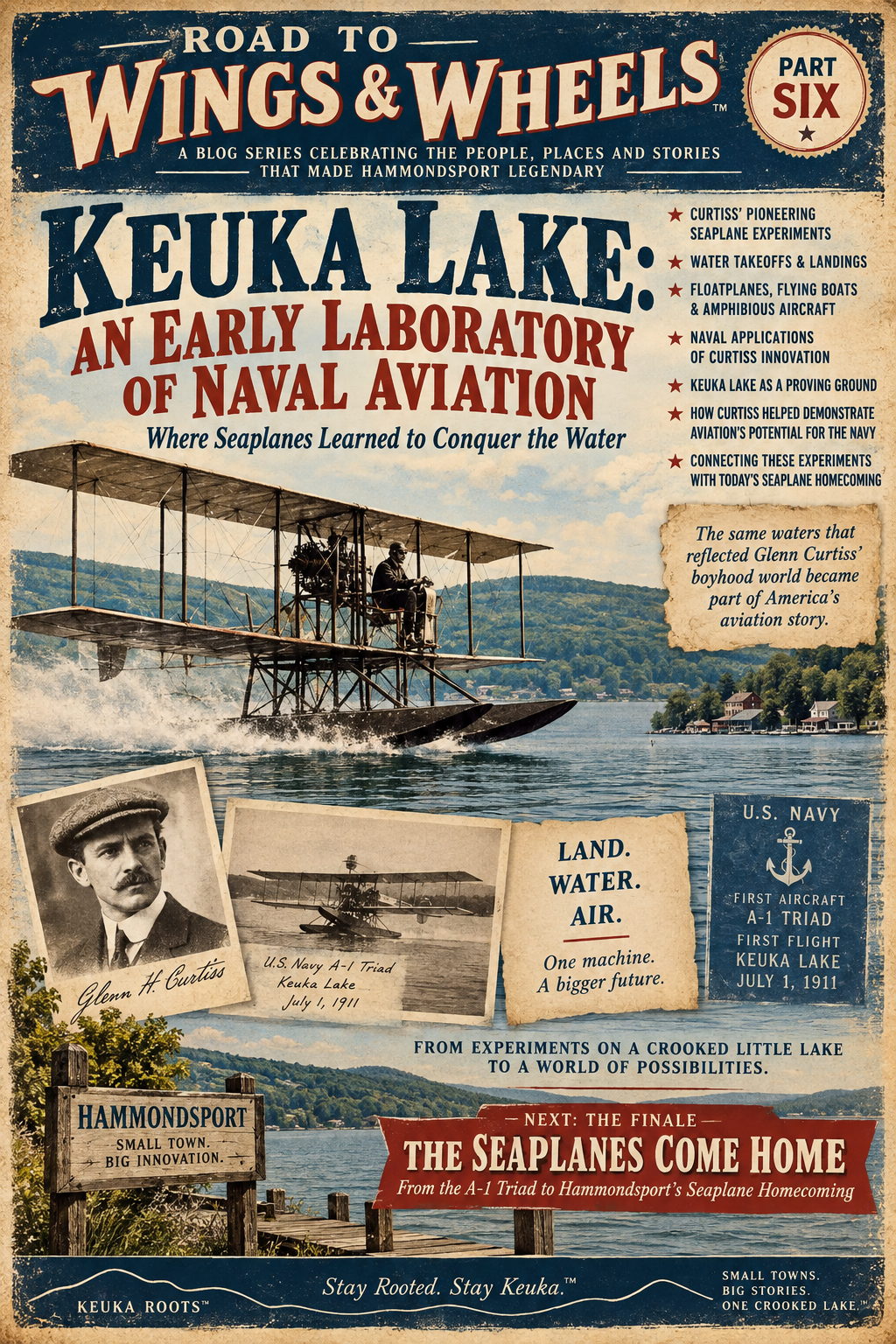
One aircraft in particular would forever connect Keuka Lake with the beginning of United States Naval Aviation.
The
Curtiss A-1 Triad.
The name Triad described exactly what made the aircraft so remarkable.
It was designed to operate in
three environments—land, water and air.
Its pontoon allowed it to operate from the water, while retractable wheels gave it the ability to operate from land.
On
May 8, 1911, Captain Washington Irving Chambers prepared requisitions for two Curtiss aircraft. The machine that became the A-1 would be the Navy's first airplane.
And then came July.
JULY 1, 1911
Picture Keuka Lake that day.
The hills rising around Hammondsport.
The water stretching north toward Penn Yan.
And sitting upon that familiar lake was a machine unlike almost anything the people along its shores had ever seen.
Glenn Curtiss took the controls.
The engine came alive.
The propeller turned.
The aircraft moved across the water.
Faster.
Faster.
Until—
the Navy's first airplane lifted from Keuka Lake.
The first flight lasted only about five minutes and reached an altitude of approximately 25 feet.
Measured against modern aviation, it sounds almost impossibly small.
But history isn't always measured by distance.
Sometimes it is measured by what happens next.
And what happened next helped change the United States Navy.
THE LAKE BECAME A CLASSROOM
The A-1 did not simply make one historic flight and disappear.
Keuka Lake became a place for testing, training and experimentation.
Lieutenant
Theodore Gordon Ellyson, who would become Naval Aviator No. 1, trained with Curtiss.
Lieutenant
John Henry Towers, another of America's earliest naval aviators, came to Hammondsport for flight training.
Captain
Washington Irving Chambers, one of the driving forces behind the Navy's embrace of aviation, worked closely with Curtiss as the possibilities of this new technology unfolded.
They weren't following a century of aviation knowledge.
They were helping write it.
Every flight could reveal another problem.
Every landing could suggest another improvement.
Every mechanical failure taught another lesson.
And Keuka Lake gave them something extraordinarily valuable:
room to experiment.
LAND. WATER. AIR.
On July 10, Curtiss demonstrated exactly why the aircraft was called the Triad.
He took off from land.
While airborne, he raised the wheels.
Then he brought the aircraft down—
onto the water.
Land.
Air.
Water.
One machine.
The possibilities for the Navy were becoming difficult to ignore.
An aircraft that could operate from water might work alongside ships without requiring the Navy to build floating runways everywhere its fleet traveled.
Aircraft could potentially scout ahead.
Observe enemy movements.
Carry messages.
Extend the eyes of a ship far beyond the horizon.
The airplane was beginning to look less like a curiosity.
It was beginning to look like a naval tool.
KEUKA LAKE AS A PROVING GROUND
Other experiments followed around Hammondsport.
In September 1911, the Navy tested an early concept for launching an airplane using an inclined wire system running from shore toward the water.
It was primitive.
Experimental.
And exactly the sort of problem Curtiss and the Navy were trying to solve:
How do you make an airplane useful aboard a ship?
Not every experiment worked perfectly.
That was the point.
Keuka Lake was a place to try.
To fail.
To modify.
To try again.
Those early Curtiss machines evolved from hydroaeroplanes and floatplanes toward larger flying boats—aircraft whose hulls were themselves designed to meet the water.
The engineering would continue to improve.
So would the engines.
So would the Navy's understanding of what aircraft could accomplish.
But the basic idea had already taken hold:
Water didn't have to stop an airplane.
FROM FLOATPLANES TO FLYING BOATS
Curtiss kept pushing.
The simple floats beneath early aircraft eventually gave way to increasingly sophisticated designs.
Flying boats became larger and more capable.
Aircraft could be designed specifically around water operations rather than merely adapted for them.
The dream grew from hopping above a lake to crossing enormous distances over open water.
Only a few years later, Curtiss-designed flying boats would become some of the most important aircraft of their kind in the world.
And in 1919, a Curtiss-designed Navy flying boat—the
NC-4—would complete the first aerial crossing of the Atlantic.
Think about that journey for a moment.
From experiments skimming across the water...
to an airplane crossing an ocean.
The distance between those achievements wasn't measured only in miles.
It was measured in imagination.
THE WATER THAT HELPED LAUNCH NAVAL AVIATION
Keuka Lake was not the only place where America's early naval aviation story unfolded.
San Diego, Annapolis and other locations played essential roles.
But Hammondsport holds a remarkable and documented place in that story.
The United States Navy's first aircraft made its first flight from Keuka Lake.
That happened here.
Not at a massive military airfield.
Not at a sprawling naval installation.
But on the waters beside a little Finger Lakes village where Glenn Curtiss had once raced bicycles and tinkered with engines.
And perhaps that is what makes the story so wonderfully Keuka.
Big things don't always begin in big places.
Sometimes they begin in workshops.
Sometimes they begin with curious boys.
Sometimes they begin with someone willing to ask:
What if?
And sometimes...
they begin on a crooked little lake.
AND THE SEAPLANES STILL COME HOME
More than a century has passed since those first Curtiss machines skimmed across Keuka Lake.
Aircraft have crossed oceans.
Naval aviation has gone from fragile wood-and-fabric machines to jets capable of launching from aircraft carriers at sea.
But every so often, something happens on Keuka Lake that makes the years seem to fold together.
A seaplane appears over the hills.
Its floats touch the water.
A wake spreads behind it.
And for just a moment, you can imagine another aircraft out there.
Wood.
Fabric.
Wires.
A Curtiss engine turning.
Glenn at the controls.
Because the seaplane story around Keuka isn't only something preserved in photographs and history books.
Every September, the seaplanes come home.
And that is where our Road to Wings & Wheels™ story is headed next.
NEXT: THE FINALE
THE SEAPLANES COME HOME
From Glenn Curtiss and the A-1 Triad to Hammondsport's Seaplane Homecoming
More than a century after the Navy's first airplane rose from Keuka Lake, seaplanes still return to the waters where so much early aviation history was written.
And this weekend, we'll watch them come home again.
🏁 THE ROAD LEADS TO HAMMONDSPORT
Every story in our
Road to Wings & Wheels series leads us back to the place where so much of it began—Hammondsport, New York, home of
Glenn H. Curtiss.
Now it’s your turn to become part of the story.
✈️ 🏍️ 🚗 WINGS & WHEELS 2026
Saturday, September 19 | 10 AM–4 PM
Hammondsport, New York
Registration is still open for participants! Bring your
seaplane, classic or special-interest car, or motorcycle and join us for a day celebrating the machines, innovation, speed, and spirit that helped put Hammondsport on the map.
Have a ride worth showing off? Enter it today and become part of Wings & Wheels!
Participant information and registration are available through the
Glenn H. Curtiss Museum.
And for everyone coming to watch, explore, photograph, reminisce, and enjoy the day—admission is FREE!
So mark your calendar, bring the family, and meet us in Hammondsport as we celebrate the remarkable legacy of Glenn Curtiss and the enduring love of
wings, wheels, and everything that moves us.
See you at Wings & Wheels!
Stay Rooted. Stay Keuka.™
Small Towns. Big Stories. One Crooked Lake.™
Keuka Roots™