By the time aviation entered Glenn Curtiss' life, he had already spent years learning lessons that would make him uniquely prepared for it.
He had been the boy who tinkered.
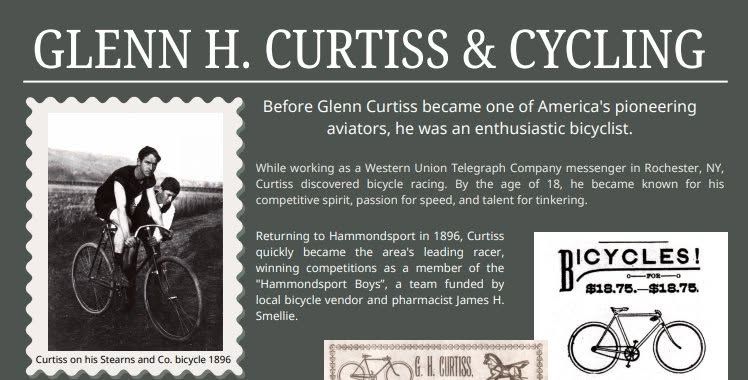
The teenager who raced bicycles.
The young man who built motorcycles.
The speed demon who strapped eight cylinders between two wheels and thundered down a Florida beach at a speed almost no human being had experienced before.
And then he turned his attention to automobiles.
Looking backward, you almost want to say:
Of course Glenn Curtiss was going to fly.
Because every machine had taught him something.
Every race had taught him something.
Every engine that worked—and probably every one that didn't—had taught him something, too.
Everything we have traveled through in our Road to Wings & Wheels series has been leading us here.
Because now…
the wheels are finally going to leave the ground.
FIRST, THERE WAS AN ENGINE
Long before Glenn Curtiss became one of America's great aviation pioneers, he had developed something extremely valuable:
A reputation.
And that reputation was built on engines.
Curtiss understood how to make engines powerful without making them unnecessarily heavy—a problem that became enormously important to the men trying to conquer flight.
An airplane couldn't simply have power.
It needed power without too much weight.
And Glenn knew a thing or two about that.
His years with bicycles had taught him about balance, weight, friction and efficiency.
Motorcycles taught him about engines, vibration, speed and control.
Racing taught him something else entirely:
A machine could look wonderful sitting still.
What mattered was what happened when you asked it to perform.
Glenn wasn't an inventor who simply drew machines on paper.
He built them.
He rode them.
He raced them.
He broke them.
Then he went back to the shop and figured out why.
That hands-on education was about to become invaluable.
Because hundreds of miles away, another famous inventor was thinking about flight.
And his name was Alexander Graham Bell.
THE TELEPHONE MAN COMES CALLING
Yes.
That Alexander Graham Bell.
By the early 1900s, Bell's curiosity had carried him far beyond the telephone.
At his estate at Baddeck, Nova Scotia, Bell was deeply interested in the possibilities of human flight. He experimented with enormous tetrahedral kites and surrounded himself with people willing to explore what still seemed impossible.
But powered flight presented a stubborn problem.
Engines.
They needed to be powerful.
They needed to be dependable.
And most importantly, they needed to be light enough to leave the earth.
That problem helped bring Bell's circle to the young engine builder from Hammondsport.
Glenn Hammond Curtiss.
Think about that for a moment.
A boy raised among the hills above Keuka Lake, who had worked in his grandmother's vineyard and raced bicycles along Finger Lakes roads, was now being drawn into the orbit of one of the most famous inventors in the world.
Not because Glenn had attended a prestigious engineering school.
Not because he had a string of academic degrees behind his name.
But because he had learned how to make things work.
And Bell recognized something in him.
So did the others who would soon join them.
In 1907, one of the most remarkable collaborations in early aviation was born.
THE AERIAL EXPERIMENT ASSOCIATION
They called it the Aerial Experiment Association, or AEA.
Its goal was wonderfully simple to say and enormously difficult to accomplish:
Get a man into the air.
The group brought together five very different men.
Alexander Graham Bell—inventor, experimenter and visionary.
Glenn Curtiss—the engine expert who was rapidly becoming much more.
Frederick "Casey" Baldwin—a talented Canadian engineer.
John A.D. McCurdy—another gifted young Canadian engineer.
And
Thomas Selfridge—a young United States Army officer fascinated by the military possibilities of aviation.
But there was another person behind the AEA whose importance deserves to be remembered.
Mabel Hubbard Bell.
Bell's wife provided crucial financial support that helped make the association's experiments possible.
While five men are generally named as the members of the AEA, a woman helped give them the freedom to experiment.
And experiment they did.
They built.
They tested.
They crashed.
They rebuilt.
They exchanged ideas.
They learned from one another.
And then they tried again.
The AEA became something of a flying laboratory.
One aircraft led to another.
The Red Wing.
The White Wing.
The June Bug.
The Silver Dart.
Each machine carried lessons learned from the one before it.
And Glenn Curtiss was right in the middle of it all.
THE MOTORCYCLE MAN LOOKS AT AN AIRPLANE
Here is where Glenn's story becomes especially fascinating.
He didn't arrive at aviation with a completely blank slate.
He brought the bicycle shop with him.
He brought the motorcycle factory with him.
He brought the racetrack with him.
He brought Ormond Beach with him.
Years spent thinking about weight, balance, power, resistance and control could now be applied to something entirely new.
Except this time, if Glenn made a mistake, the machine wasn't simply going to wobble across a road.
It could fall out of the sky.
Aviation demanded a different kind of precision.
Glenn learned to fly.
He helped design aircraft.
He supplied and developed engines.
He experimented with control systems.
And once again, the same pattern appeared that had followed him since childhood:
Try it.
Watch what happens.
Find the problem.
Change it.
Try again.
Only now…
the workshop had become the sky.
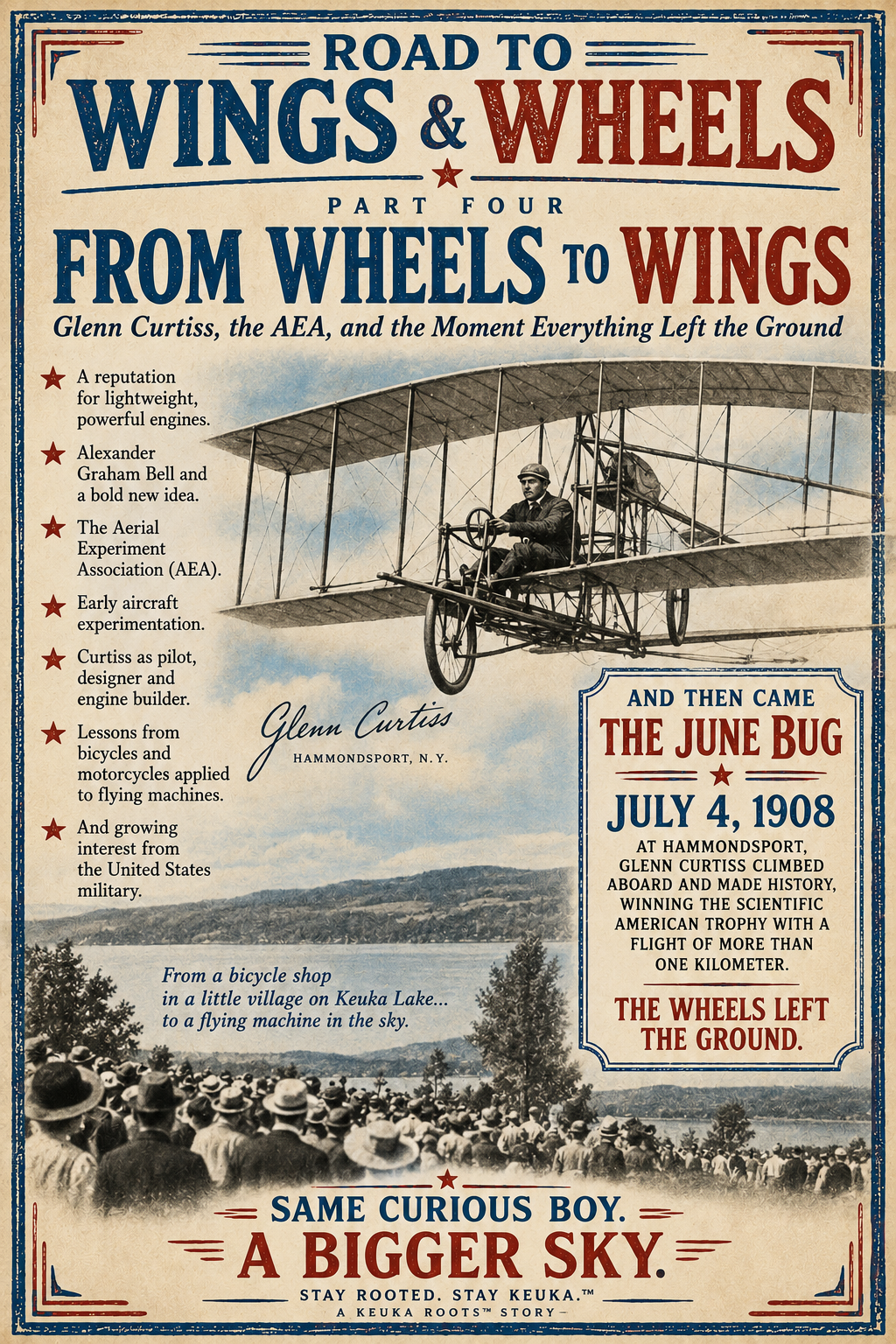
THE JUNE BUG
If there is one early Curtiss airplane every Keuka Lake kid should know, it might just be this one.
The June Bug.
Because on July 4, 1908, Glenn Curtiss climbed aboard that strange-looking flying machine at Hammondsport and prepared to attempt something historic.
The challenge was the Scientific American Trophy.
To win it, an aircraft had to make a publicly observed flight of at least one kilometer.
Now imagine Hammondsport that day.
The summer heat.
People gathering.
Faces turned toward the field.
The hills rising around them.
And there, sitting on the ground, was a strange machine of wood, wire and fabric.
At its controls sat Glenn Curtiss.
The same Glenn who had once raced bicycles along these roads.
The same Glenn who had built motorcycles in Hammondsport.
The same Glenn who had become the Fastest Man on Earth on a Florida beach.
The engine roared.
The June Bug began moving.
Faster.
Faster.
And then—
the wheels left the ground.
Glenn flew.
Not for a few feet.
Not for a lucky hop.
He flew more than a kilometer and won the trophy.
The motorcycle racer from Hammondsport had become an aviator.
And American aviation had taken another enormous step forward.
THE WORLD WAS BEGINNING TO PAY ATTENTION
And so was the United States military.
That matters.
Because when we tell the story of Glenn Curtiss and American aviation, it's tempting to jump directly from the June Bug to Navy airplanes, seaplanes and flight schools.
But those things didn't happen overnight.
The relationship was built one experiment at a time.
The AEA already had a military connection sitting at the workbench.
Lieutenant Thomas Selfridge represented the United States Army.
Military leaders were beginning to understand that these strange machines being tested by Curtiss and other aviation pioneers might someday become much more than spectacles.
An airplane could scout.
It could observe.
It could carry messages.
It could completely change the way wars were fought.
No one yet understood just how dramatically.
But the possibility was there.
And Glenn Curtiss was becoming one of the men the United States military needed to watch.
FROM WHEELS TO WINGS
This may be my favorite part of Glenn's story.
Because suddenly, when you look backward, you realize:
None of it was wasted.
The bicycles mattered.
The motorcycles mattered.
The engines mattered.
The races mattered.
The automobiles mattered.
Even the failures mattered.
Every chapter had quietly prepared Glenn Curtiss for the next one.
The bicycle taught him to understand a machine beneath his body.
The motorcycle taught him to combine lightweight construction with increasing power.
Racing taught him to trust what testing revealed rather than what theory promised.
Engine building gave him something aviation desperately needed.
And the Aerial Experiment Association gave him the opportunity to bring all those lessons together.
From a bicycle shop in a little village on Keuka Lake…
to motorcycles…
to automobiles…
to Alexander Graham Bell…
to the AEA…
to a strange little flying machine called the June Bug.
On July 4, 1908, those worlds finally came together.
The wheels left the ground.
But if you know anything about Glenn Curtiss by now, you already know what comes next.
He wasn't going to be satisfied simply because he had learned how to fly.
There was another problem waiting to be solved.
And Glenn had spent much of his life staring at it.
Water.
Lots and lots of water.
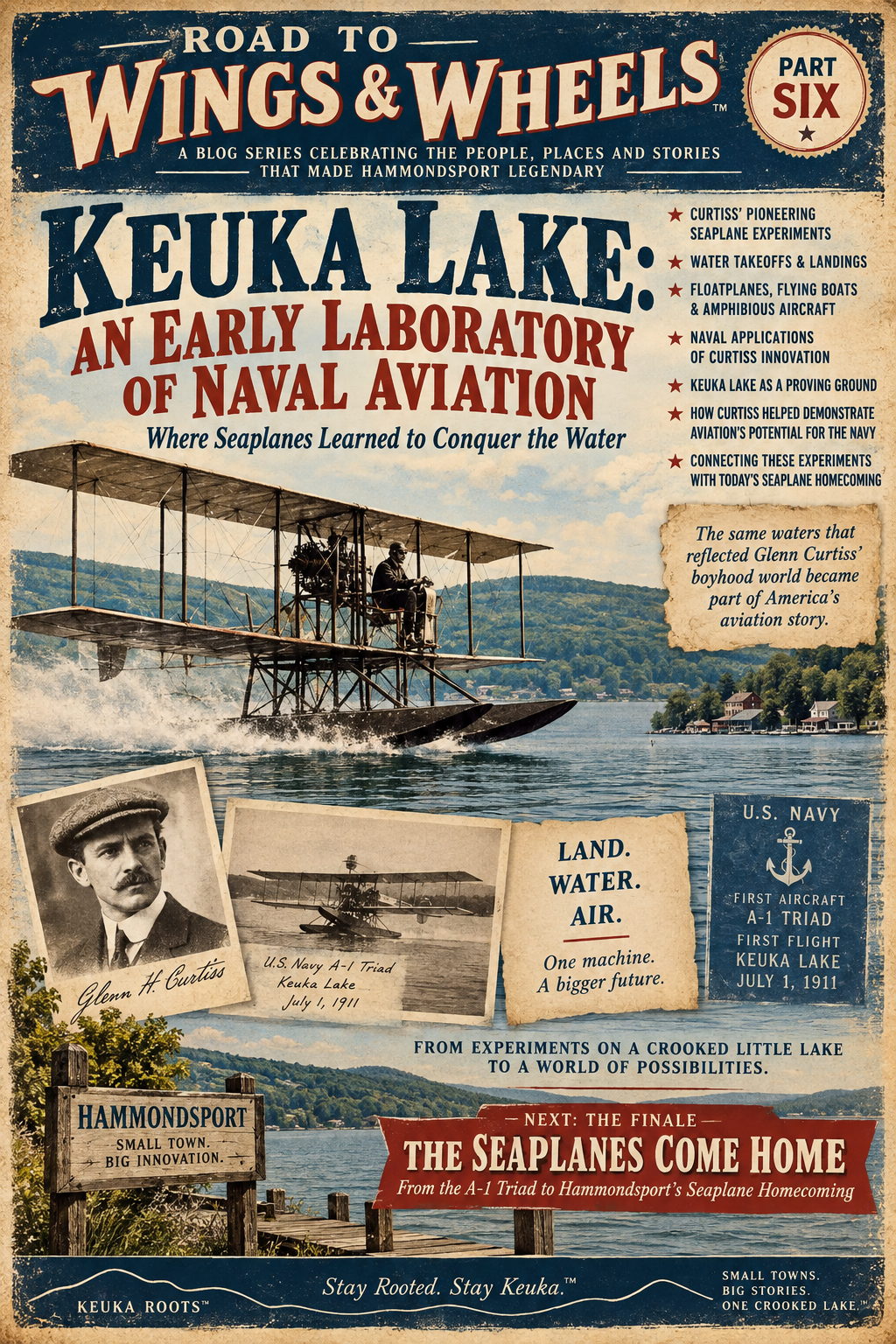
After all, this was a boy who had grown up beside Keuka Lake.
Soon, the crooked lake would become more than the backdrop to Glenn Curtiss' story.
It would become his laboratory.
Floats would replace wheels.
Airplanes would meet water.
Military officers would begin arriving in Hammondsport.
And one young naval officer named Theodore Gordon "Spuds" Ellyson would come to Keuka Lake to learn from Glenn Curtiss.
The boy who raced bicycles around Hammondsport…
The man who became the fastest on earth…
The inventor who finally left the ground…
was about to help teach the United States Navy how to fly.
And that, friends, is where we're headed next.
COMING NEXT IN ROAD TO WINGS & WHEELS
Part Five | THE BOY WHO BUILT THE NAVY'S WINGS
Keuka Lake becomes a flying laboratory—and America's first naval aviator comes to Hammondsport.
🏁 THE ROAD LEADS TO HAMMONDSPORT
Every story in our
Road to Wings & Wheels series leads us back to the place where so much of it began—Hammondsport, New York, home of
Glenn H. Curtiss.
Now it’s your turn to become part of the story.
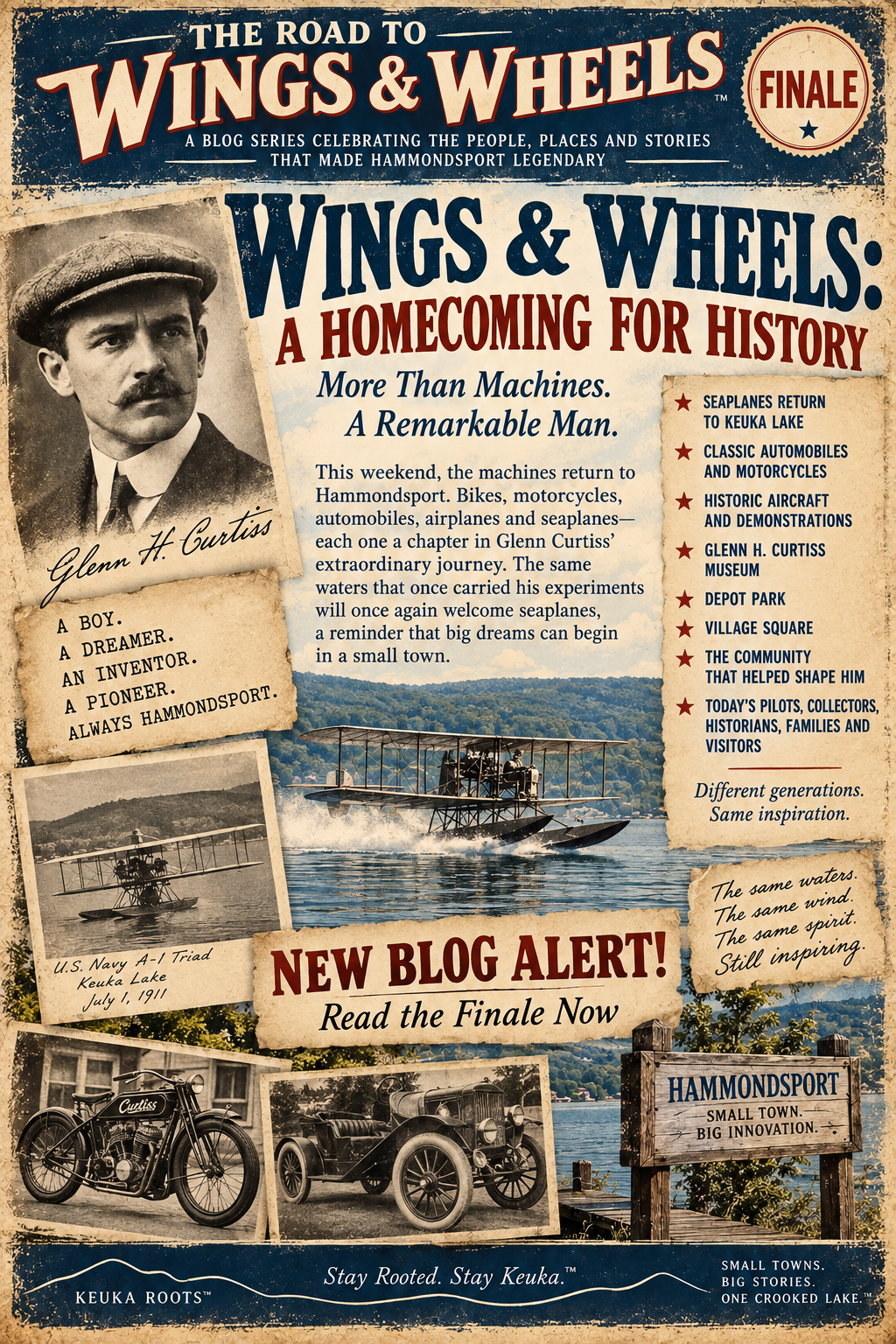
✈️ 🏍️ 🚗 WINGS & WHEELS 2026
Saturday, September 19 | 10 AM–4 PM
Hammondsport, New York
Registration is still open for participants! Bring your
seaplane, classic or special-interest car, or motorcycle and join us for a day celebrating the machines, innovation, speed, and spirit that helped put Hammondsport on the map.
Have a ride worth showing off? Enter it today and become part of Wings & Wheels!
Participant information and registration are available through the
Glenn H. Curtiss Museum.
And for everyone coming to watch, explore, photograph, reminisce, and enjoy the day—admission is FREE!
So mark your calendar, bring the family, and meet us in Hammondsport as we celebrate the remarkable legacy of Glenn Curtiss and the enduring love of
wings, wheels, and everything that moves us.
See you at Wings & Wheels!
Stay Rooted. Stay Keuka.™
Small Towns. Big Stories. One Crooked Lake.™