ROAD TO WINGS & WHEELS Part Three | G.H. AND THE AUTOMOBILE
ROAD TO WINGS & WHEELS
Part Three | G.H. AND THE AUTOMOBILE
Four wheels, aviation engines, a flying car—and another machine Glenn Curtiss couldn't resist reimagining.
There is a pattern developing in the story of Glenn Hammond Curtiss.
Give G.H. a machine and he will use it.
For a little while.
Then he'll start looking at it differently.
How does it work?
Why was it built this way?
What could be changed?
Could it be lighter?
Could it be stronger?
Could it be faster?
And perhaps the most Glenn Curtiss question of all:
What else could it become?
We have already followed him from the bicycle shop to motorcycle manufacturing.
We've watched him become fascinated with engines.
We've followed him to Florida, where in 1907 he climbed aboard his extraordinary V-8 motorcycle and traveled approximately 136 miles per hour across Ormond Beach.
But motorcycles weren't the only machines transforming America.
Another mechanical revolution was rumbling down the road.
The automobile.
And, of course, G.H. couldn't leave it alone.
FIRST, AN IMPORTANT DISTINCTION
Glenn Curtiss did not become a traditional automobile manufacturer.
There wasn't a Curtiss equivalent of the Ford Motor Company turning out thousands of Glenn-designed passenger cars. (Though there are reports that Glenn did know Henry Ford and Henry Ford perhaps even visited Hammondsport!)
His relationship with automobiles was much more characteristic of G.H.
Glenn brought his experience with engines, lightweight construction, speed and eventually aviation and aerodynamics into the automobile world.
He fitted automobiles with Curtiss engines.
He experimented with customized vehicles.
He explored streamlined forms and unusual coachwork.
And eventually, he began blurring the line between automobile and airplane altogether.
In other words, Glenn didn't look at an automobile and simply think:
I should build one of those.
He seemed more inclined to ask:
What can I do to one of those?
And eventually:
What else can one of those become?
AMERICA GETS BEHIND THE WHEEL
To appreciate Glenn's fascination with automobiles, we need to forget almost everything we know about driving today.
At the beginning of the twentieth century, the automobile was still a technological adventure.
Horses remained everywhere.
Many roads were terrible.
Gas stations weren't conveniently waiting at every intersection.
There were no interstate highways.
No roadside service centers.
No computer diagnostics.
Early automobiles could be noisy, uncomfortable, temperamental and wonderfully unreliable.
They overheated.
Tires failed.
Engines misbehaved.
Parts broke.
Sometimes getting to your destination required nearly as much mechanical ability as driving skill.
For some people, those problems were reasons to distrust the automobile.
For Glenn Curtiss?
They were invitations.
Because every weakness represented something that could be improved.
And back home in Hammondsport, G.H. and Lena weren't simply watching the automobile age arrive.
They were getting behind the wheel.
DID YOU KNOW? G.H. & LENA WERE FIRST
Here is one of those wonderful little pieces of Hammondsport history that makes Glenn's story feel less like something from a history book and more like something that happened right here in our village.
Glenn and Lena Curtiss owned the first automobiles in Hammondsport.
Imagine that scene.
Hammondsport streets were still familiar with horses and wagons.
Bicycles were everywhere.
The automobile was still something many people had never experienced firsthand.
And then along came the Curtiss’.
You can almost imagine people stopping along the village street when they heard the unfamiliar sound approaching.
An engine.
Four wheels.
No horse.
And behind the wheel?
G.H.
Perhaps even more interesting is Lena.
She had an automobile of her own.
That detail feels wonderfully appropriate for the young couple.
Lena wasn't simply sitting beside her mechanically obsessed husband while he experimented with another new machine.
She was driving too.
It gives us another glimpse of the partnership between Glenn and Lena and of the remarkably modern world developing around them.
They had watched bicycles transform personal transportation.
They had lived through Glenn's transition into motorcycles.
They had seen engines grow increasingly powerful.
And now the automobile was arriving.
For Hammondsport, the future wasn't something happening somewhere far away in New York City, Detroit or another great industrial center.
Sometimes the future came right down the village street.
And G.H. and Lena were behind the wheel.
G.H. MEETS FOUR WHEELS
By the time automobiles were becoming increasingly important, Glenn already possessed an extraordinary mechanical education.
Not the kind earned in a university classroom.
His education came from workbenches.
Bicycle races.
Motorcycle races.
Engines.
Broken parts.
Manufacturing.
And thousands of hours spent asking why one mechanical solution worked better than another.
Automobiles presented many of the same questions Glenn had already been exploring.
Power.
Weight.
Cooling.
Lubrication.
Fuel.
Vibration.
Efficiency.
Reliability.
But now they were contained within a larger and increasingly complicated machine.
And Glenn possessed something especially valuable.
Engines.
PUT A CURTISS ENGINE IN IT
This is where Glenn's automobile story becomes particularly fun.
He didn't need to manufacture an entire automobile to transform one.
Glenn had spent years developing increasingly powerful engines, including the V-type engines that helped establish his reputation in motorcycles and aviation.
So what happens when a man like Glenn Curtiss looks at an automobile and knows he has a powerful engine sitting nearby?
You can probably guess.
He puts a Curtiss engine in it.
Glenn fitted automobiles with his own engines, including cars powered by the Curtiss OX-5 V-8, the famous engine associated with early American aviation.
Think about that combination.
An automobile chassis.
An aircraft engine.
And Glenn Curtiss.
Long before enormous engines, custom modifications and high-performance conversions became an established part of American automobile culture, Glenn was already experimenting with what happened when you put considerably more interesting power into a car.
It is one reason he has sometimes been described as something of an early “hot rodder” in spirit.
Not because Glenn was part of the later hot-rod movement.
He wasn't.
But the instinct feels familiar:
Take an existing automobile.
Change it.
Give it different power.
Improve its performance.
Make it distinctly your own.
That certainly sounds like G.H.
BUT POWER WASN'T THE ONLY QUESTION
By this stage in his career, Glenn's thinking had moved well beyond simply making engines more powerful.
Aviation was teaching him something else.
Air matters.
A machine doesn't simply move.
It moves through something.
And at higher speeds, the shape of that machine increasingly matters.
Resistance matters.
Drag matters.
Weight matters.
Form matters.
The lessons Glenn learned in aviation could travel right back to the road.
He became interested in streamlined vehicle design and unusual custom coachwork, bringing ideas influenced by aviation into automobiles.
This is another recurring theme in the Curtiss story.
Glenn didn't seem to believe that knowledge belonged in neat little boxes.
A lesson learned from a bicycle could improve a motorcycle.
A motorcycle engine could help solve a problem in aviation.
An aviation engine could power an automobile.
Aerodynamic principles learned in the air could influence something traveling along a road.
Everything connected.
THE AUTOMOBILE BECOMES ANOTHER LABORATORY
That's why automobiles deserve their own chapter in the Curtiss story.
Glenn's fascination was never really about bicycles.
Or motorcycles.
Or automobiles.
Or even airplanes.
It was about movement.
How can humans travel farther?
Faster?
More efficiently?
More comfortably?
How can a machine be improved?
And what happens when you stop accepting the traditional boundaries between different kinds of transportation?
Glenn had spent much of his life doing exactly that.
Bicycles became motorcycles.
Motorcycle engines helped lead him toward aviation.
Aviation technology came back to the automobile.
And eventually Glenn would take the connection between the car and the airplane to its almost inevitable conclusion.
He would try to combine them.
YES, G.H. TRIED A FLYING CAR
It sounds like something from the future.
Except Glenn Curtiss was working on it more than a century ago.
In 1917, he introduced one of his most fascinating experiments:
THE CURTISS AUTOPLANE
Part automobile.
Part airplane.
Part glimpse into a future that still fascinates engineers today.
The Autoplane represented an attempt to combine road transportation with flight.
And really—
who else would look at an automobile and an airplane and decide the obvious next step was to put them together?
It represented the natural progression of the questions Glenn had been asking since childhood.
Why must a machine do only one thing?
Why must transportation remain divided into separate categories?
Why couldn't something that traveled on the ground also travel through the air?
The Autoplane did not become an everyday flying automobile.
But the idea itself tells us something important about Glenn.
He wasn't merely solving the transportation problems of his own day.
He was constantly imagining what transportation might look like tomorrow.
FROM THE AUTOPLANE TO THE AEROCAR
And even after aviation had made Glenn internationally famous, his fascination with ground transportation didn't disappear.
Later in life, Glenn turned his attention toward another increasingly American idea:
travel for the sake of adventure.
The automobile was giving people something earlier generations rarely possessed.
Freedom.
Families could travel independently.
Explore.
Vacation.
Take the road simply to see where it went.
Glenn began thinking about what people might want to bring with them.
Comfort.
Living space.
A place to sleep.
A home that could travel.
Once again, he applied aviation thinking to a ground vehicle.
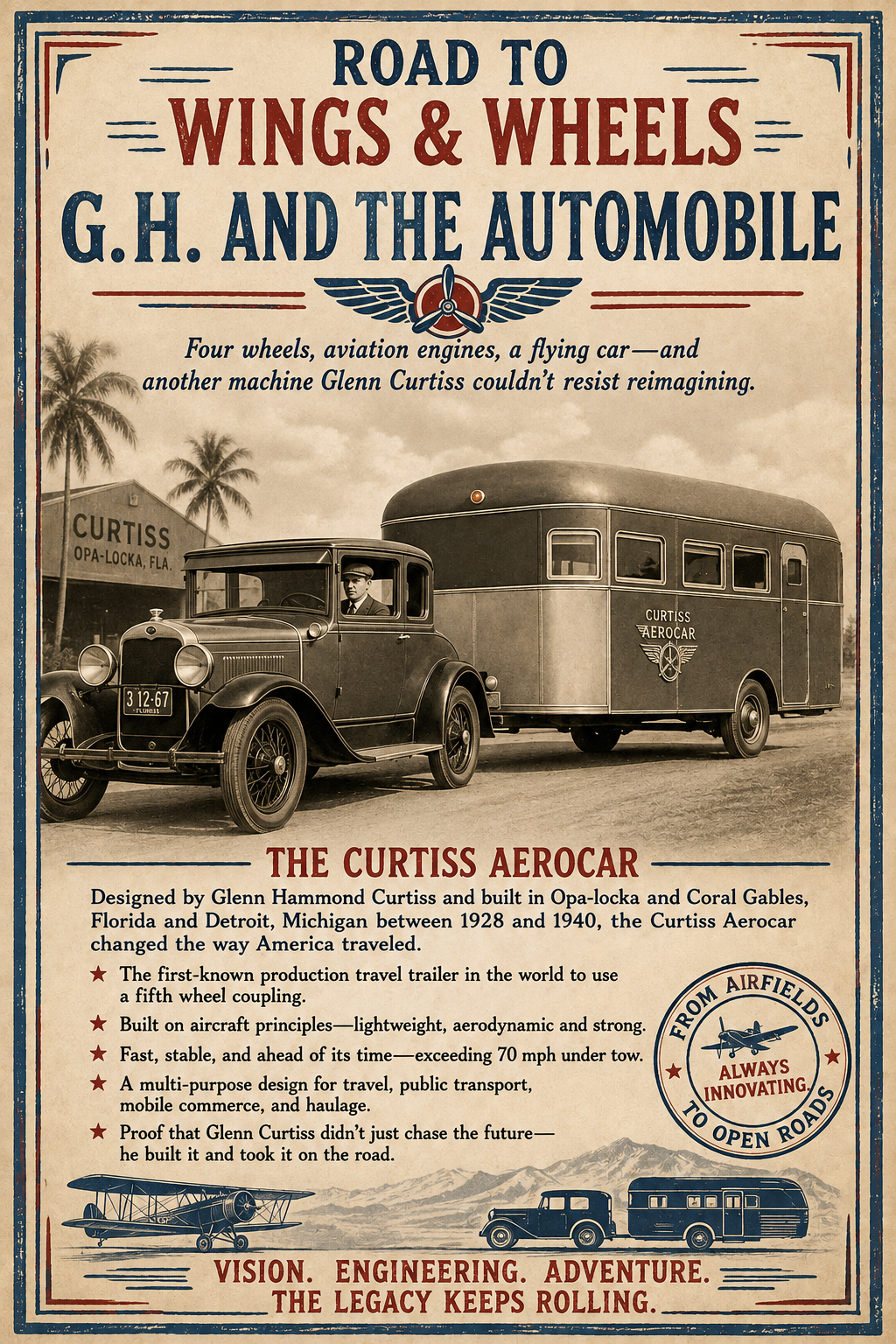
The result eventually included the remarkable Curtiss Aerocar.
G.H. GOES CAMPING — CURTISS STYLE
Calling the Aerocar simply a travel trailer doesn't quite capture the spirit of it.
Glenn brought aerodynamic ideas and lightweight construction principles into recreational transportation.
Instead of treating a trailer as merely a box pulled behind a car, he thought about airflow.
Weight.
Shape.
Stability.
Efficiency.
Sound familiar?
Of course it does.
Because Glenn was still asking variations of the questions he'd asked decades earlier in Hammondsport.
How can I make it lighter?
How can I make it move better?
How can I reduce resistance?
How can I improve what already exists?
The boy who once tinkered with bicycles was now applying aviation principles to recreational vehicles.
Different machine.
Same G.H.
FROM A HAMMONDSPORT BICYCLE SHOP TO A FLYING CAR
When you place all these chapters beside one another, the Curtiss story becomes even more remarkable.
Glenn begins with bicycles.
Then motorcycles.
Then his own engines.
Then motorcycle manufacturing.
Then aviation.
Then aviation engines find their way into automobiles.
Then streamlined automotive ideas.
Then a flying automobile.
Then aerodynamic recreational vehicles.
It isn't a straight line.
It's a web of ideas.
One invention feeds another.
One mechanical problem teaches him something useful somewhere else.
One mode of transportation becomes inspiration for the next.
That may be one of the best ways to understand Glenn Curtiss.
He didn't necessarily see a bicycle, motorcycle, automobile, airplane and recreational vehicle as entirely separate worlds.
He saw machines designed to move people.
And machines could always be improved.
AND THEN THERE WAS HENRY FORD
Yes, there really is one more wonderful connection between Glenn Curtiss and the automobile world.
Henry Ford.
Consider for a moment how unlikely this entire story must once have seemed.
A boy grows up in tiny Hammondsport, New York.
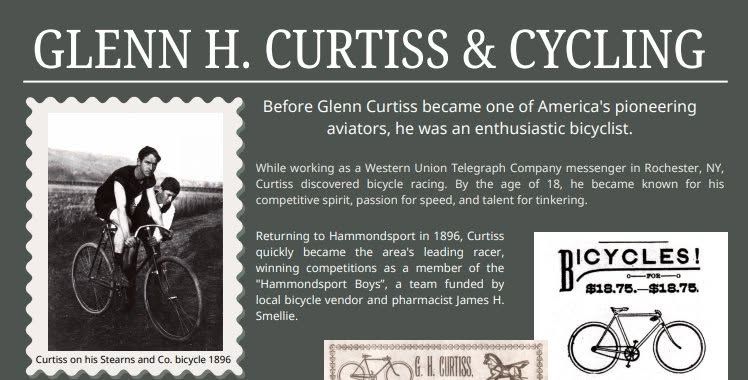
He races bicycles with Tank Waters.
Works around James Smellie's bicycle business.
Opens his own shop.
Builds motorcycles.
Manufactures engines.
Becomes famous for speed.
Helps pioneer aviation.
Experiments with automobiles.
And eventually moves in a world that includes some of the greatest inventors and industrialists of the age.
Alexander Graham Bell.
Henry Ford.
Men whose ideas transformed how Americans communicated and traveled.
Ford revolutionized transportation by helping make the automobile accessible to millions.
Curtiss helped revolutionize transportation by taking humanity into the air.
Different men.
Different machines.
But they shared a fundamental belief that technology could change the distance between people and places.
And somewhere in that enormous story is an image worth remembering:
G.H. and Lena driving some of Hammondsport's very first automobiles through the streets of their hometown.
Before the famous visitors.
Before the aviation factories.
Before naval officers and pilots arrived on Keuka Lake.
Before Glenn Curtiss became one of the most important names in American aviation—
there was a young couple in Hammondsport embracing a brand-new way of getting around.
SO WHY AUTOMOBILES IN A STORY ABOUT WINGS & WHEELS?
Because Wings & Wheels tells a bigger story than airplanes.
It celebrates the remarkable transportation world Glenn Curtiss inhabited and helped shape.
Bicycles.
Motorcycles.
Automobiles.
Engines.
Aircraft.
Machines on land.
Machines in the air.
And eventually, machines designed to operate from water.
The classic automobiles that return to Hammondsport for Wings & Wheels aren't disconnected from the Curtiss story.
Quite the opposite.
They represent another chapter in an era when transportation was changing at breathtaking speed.
And Glenn Curtiss stood almost exactly where those worlds intersected.
He raced on two wheels.
Experimented on four.
Flew on wings.
And eventually helped create machines capable of moving between land, water and sky.
But perhaps the most fascinating thing about Glenn wasn't the number of different machines he touched.
It was the question he brought to every one of them.
A question that may have first taken shape in a bicycle shop in Hammondsport:
“How can I make it better?”
That question took G.H. from the streets of a little village beside Keuka Lake to motorcycle speed records, automobile experiments, aviation history, flying cars and beyond.
And we're still nowhere near finished with his story.
Because before there could be naval aviation on Keuka Lake...
before the flying boats...
before Navy pilots came to Hammondsport...
another famous inventor was about to discover that an extraordinary engine builder lived beside a crooked lake in the Finger Lakes.
His name was Alexander Graham Bell.
And he was looking for someone who understood lightweight engines.
He found G.H.
Next on The Road to Wings & Wheels™
WHEN ALEXANDER GRAHAM BELL CAME CALLING
The Aerial Experiment Association—and the moment Glenn Curtiss's world moved from the road toward the sky.
🏁 THE ROAD LEADS TO HAMMONDSPORT
Every story in our Road to Wings & Wheels series leads us back to the place where so much of it began—Hammondsport, New York, home of Glenn H. Curtiss.
Now it’s your turn to become part of the story.
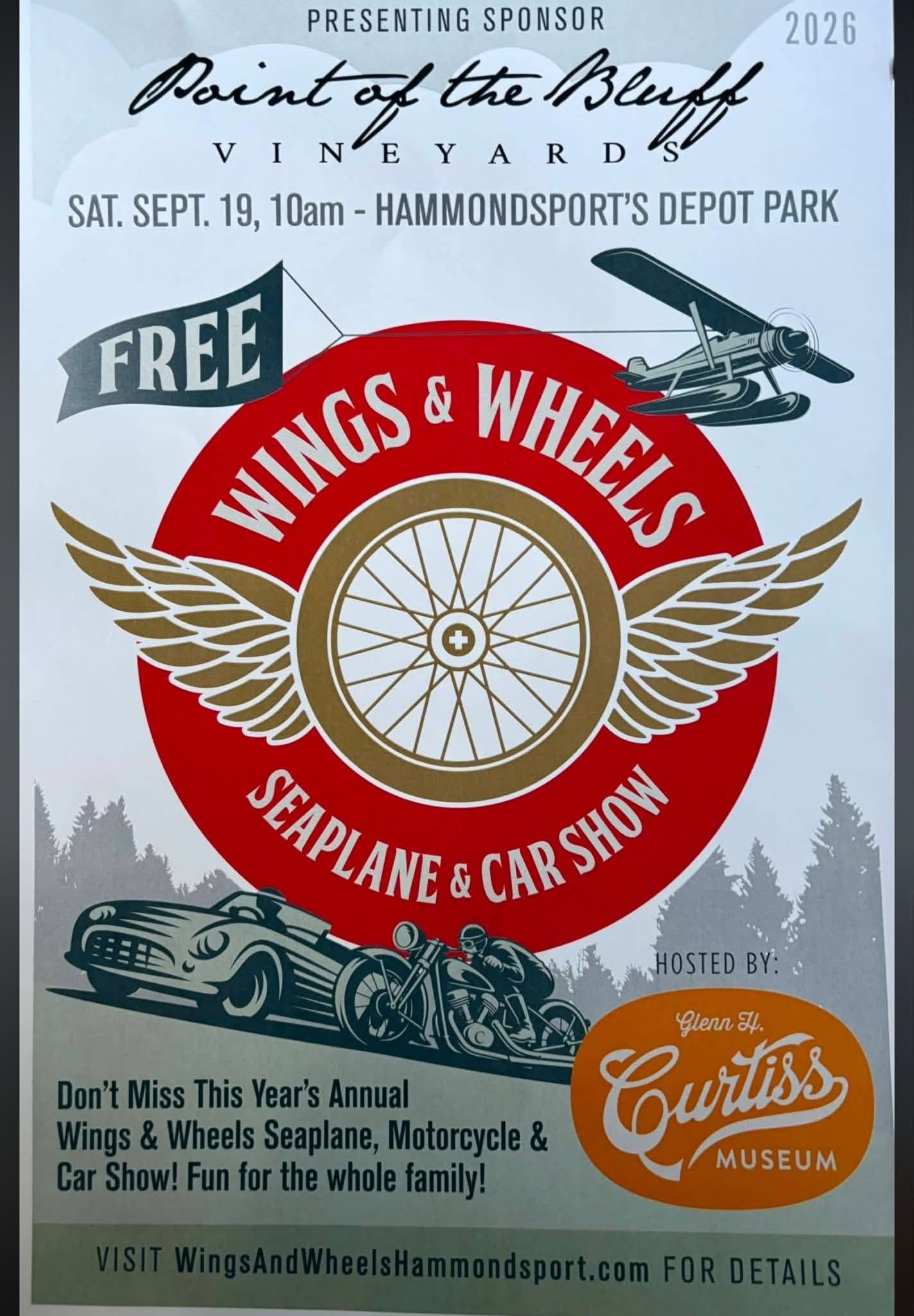
✈️ 🏍️ 🚗 WINGS & WHEELS 2026
Saturday, September 19 | 10 AM–4 PM
Hammondsport, New York
Registration is still open for participants! Bring your seaplane, classic or special-interest car, or motorcycle and join us for a day celebrating the machines, innovation, speed, and spirit that helped put Hammondsport on the map.
Have a ride worth showing off? Enter it today and become part of Wings & Wheels!
Participant information and registration are available through the Glenn H. Curtiss Museum.
And for everyone coming to watch, explore, photograph, reminisce, and enjoy the day—admission is FREE!
So mark your calendar, bring the family, and meet us in Hammondsport as we celebrate the remarkable legacy of Glenn Curtiss and the enduring love of wings, wheels, and everything that moves us.
See you at Wings & Wheels!
Keuka Roots™
Small Towns. Big Stories. One Crooked Lake.™
Stay Rooted. Stay Keuka.™