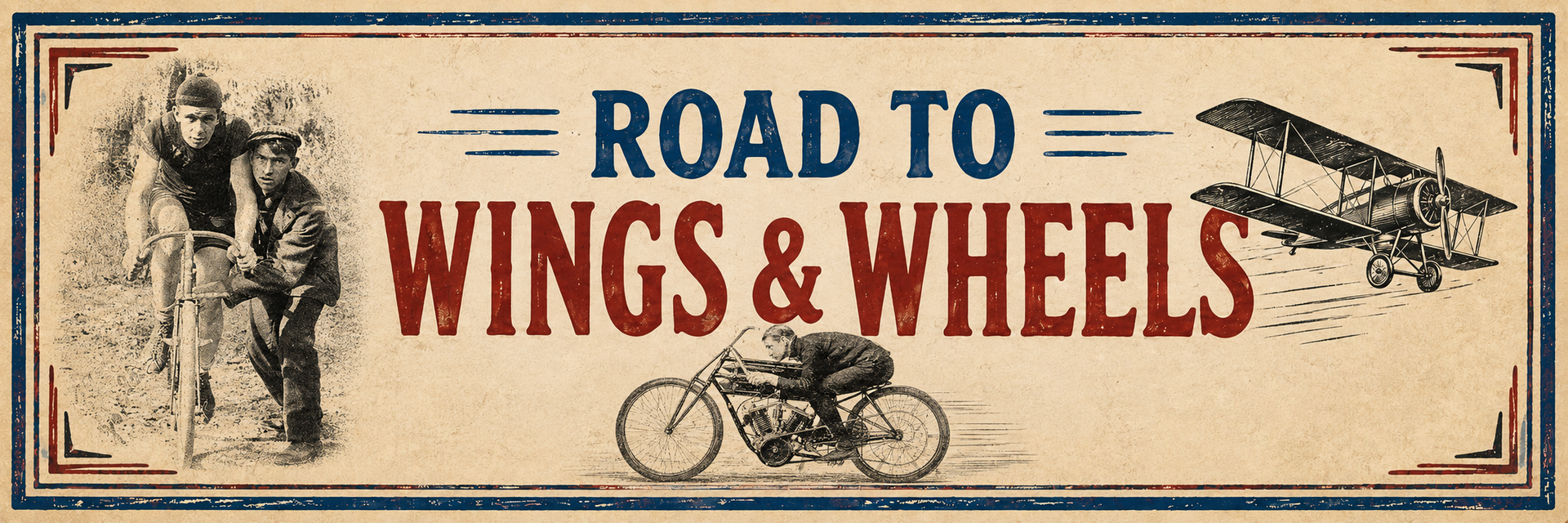
ROAD TO WINGS & WHEELS Part Two | THE FASTEST MAN ON EARTH
THE FASTEST MAN ON EARTH
From a bicycle shop in Hammondsport to motorcycle manufacturing—
and 136 miles per hour on a Florida beach.
In Part One of our Road to Wings & Wheels™, we met G.H. before the world knew the name Glenn Curtiss.
We found him racing bicycles with Tank Waters and the Hammondsport Boys, working for James Smellie, opening his own bicycle business and discovering that he wasn't content simply to repair a machine.
Glenn needed to understand it.
Why did it work?
Why didn't it work?
Could it be lighter?
Could it be stronger?
Could it be faster?
Could it be better?
Those questions followed Glenn everywhere.
And eventually, a bicycle could no longer answer them.
Something new was capturing his imagination.
The engine.
And once Glenn Curtiss discovered engines, the little bicycle shop in Hammondsport was about to become something much bigger.
FROM PEDALS TO POWER
Bicycles become motorcycles.
Motorcycles become engines.
And the engines become increasingly powerful.
For G.H., each step is connected to the one before it.
He isn't chasing speed simply for the thrill of going faster.
Speed is teaching him.
Every race is an experiment.
Every engine is a question.
Every mechanical failure is another problem waiting to be solved.
How much power can an engine produce?
How light can it be?
How efficiently can that power reach the wheel?
How do you keep an engine running when you push it beyond anything it was designed to do?
And when something breaks?
Glenn wants to know why.
This is one of the most important things to understand about Glenn Curtiss.
He wasn't simply a daredevil.
He was an experimenter.
The race provided something a workshop couldn't always provide:
proof.
On the workbench, an idea might look promising.
On the road, it had to perform.
A machine didn't care about reputation.
It didn't care how clever its inventor believed himself to be.
It either worked—
or it didn't.
And Glenn loved finding out.
THE ENGINE BECOMES THE OBSESSION
There was something about the internal-combustion engine perfectly suited to Glenn's mind.
It was mechanical, but filled with possibilities.
Fuel.
Air.
Compression.
Ignition.
Heat.
Friction.
Timing.
Cooling.
Lubrication.
Weight.
Power.
Every part affected another.
Change one thing and something else might improve—or fail completely.
To many people, an engine was simply something that made a machine move.
To Glenn, it was a puzzle waiting to be solved.
And one question became increasingly important:
How much useful power could you produce with the least possible weight?
At first, Glenn was trying to make motorcycles better.
Faster.
More reliable.
More powerful.
But without yet knowing where those experiments would ultimately take him, he was developing precisely the expertise that another emerging technology desperately needed.
Aviation.
That would come later.
First, Glenn had a motorcycle company to build.
THE BICYCLE SHOP BEGINS TO CHANGE
This is an important part of the Curtiss story because Glenn did not simply leap from repairing bicycles to racing a giant V-8 motorcycle on Ormond Beach.
There was a business being built between those two moments.
It began modestly.
Glenn became fascinated with the small gasoline engines beginning to appear around the turn of the century.
Adding an engine to a bicycle wasn't simply a way to eliminate pedaling.
For Glenn, it opened an entirely new mechanical world.
Now there was fuel to understand.
Ignition to perfect.
Cooling to improve.
Vibration to control.
Weight to reduce.
Power to increase.
One problem led directly to another.
And Glenn loved problems.
Soon he was experimenting with motorized bicycles.
But Glenn being Glenn, using whatever engine happened to be available wasn't going to satisfy him for very long.
If the engine wasn't good enough, there was an obvious solution.
Build a better one.
That decision changed everything.
Glenn was no longer simply repairing someone else's machine.
He was creating his own.
THE CURTISS MOTORCYCLE
Soon motorcycles bearing the Curtiss name were taking shape in Hammondsport.
And Glenn possessed an unusual advantage.
He wasn't simply the man designing the machine.
He wasn't simply the mechanic building it.
He wasn't simply the businessman selling it.
He could climb aboard and race it himself.
That combination was powerful.
Glenn could design an engine.
Build it.
Mount it in a motorcycle.
Race the machine.
Feel exactly how it performed.
Then return to Hammondsport and improve it.
If something failed, Glenn didn't have to wait for a rider to explain what had happened.
He had been the rider.
He felt the vibration.
The hesitation.
The acceleration.
The heat.
The response of the engine beneath him.
The instant something wasn't quite right.
Then it was back to the shop.
Adjust.
Rebuild.
Test.
Race.
Repeat.
The racetrack had become an extension of Glenn Curtiss's workbench.
FROM BICYCLE SHOP TO MANUFACTURING COMPANY
And gradually, the scale of Glenn's world changed again.
What had begun with bicycles in a small Hammondsport shop grew into motorcycle and engine manufacturing.
Glenn organized the G.H. Curtiss Manufacturing Company, and motorcycles and engines bearing the Curtiss name began making their way far beyond Keuka Lake.
Pause there for a moment.
Because this is an extraordinary transformation.
The boy who once raced Tank Waters down the roads of Hammondsport was now building motorcycles for other people to ride and race.
The young man who had repaired bicycles was becoming a manufacturer.
And the little village where he had grown up was becoming a place where increasingly sophisticated machines were being built.
Glenn was learning far more than mechanics.
He was learning how to turn an idea into a product.
How to build something repeatedly.
How to fill orders.
How to work with employees and suppliers.
How to improve a design while continuing to manufacture it.
How to balance experimentation with the realities of running a business.
How to take something imagined at a workbench and build it for the wider world.
Glenn Curtiss was no longer simply becoming an inventor.
He was becoming an industrialist.
And beside him was Lena.
BUILDING IT TOGETHER
As Glenn's mechanical ambitions grew, so did the practical demands of the business.
Bills.
Orders.
Customers.
Payroll.
Suppliers.
Accounts.
And this is where Lena Pearl Neff Curtiss becomes such an important part of the story.
Lena wasn't simply standing on the sidelines watching her husband's success.
She worked beside G.H.
She kept books and helped provide practical structure beneath Glenn's increasingly ambitious ideas.
Glenn sees another engine.
Lena sees the invoice.
Glenn sees another experiment.
Lena knows what is in the account.
Glenn sees possibility.
Lena understands what it will take to make that possibility sustainable.
Together, they watched a bicycle business become a motorcycle business.
And the motorcycle business was becoming something neither could yet fully imagine.
HAMMONDSPORT — WHERE THINGS WERE BUILT
This is another reason Hammondsport matters so deeply to the Glenn Curtiss story.
Glenn didn't have to leave his little hometown before he could begin doing extraordinary things.
He built them there.
Hammondsport wasn't simply his birthplace.
It became his workshop.
His proving ground.
His manufacturing base.
The village roads and surrounding hills helped test bicycles and motorcycles.
Friends became helpers, employees and companions.
Lena helped support the growing enterprise.
And the mechanical knowledge accumulating inside Glenn's operation became increasingly sophisticated.
Before Hammondsport became famous for airplanes, another sound was beginning to echo through the village.
Engines.
Engines being built.
Engines being adjusted.
Engines being tested.
Curtiss motorcycles leaving the shop.
And G.H. asking the question that seemed to follow every accomplishment:
What comes next?
THE RACETRACK BECOMES A LABORATORY
Competition gave Glenn a brutal but effective way of answering that question.
Race it.
If another motorcycle outran his, he wanted to understand why.
If his engine overheated, he wanted to know what caused it.
If vibration damaged a component, that component needed improvement.
If additional weight cost him speed, something had to become lighter.
If more power created another problem, then that problem became tomorrow's work.
Build it.
Test it.
Break it.
Study it.
Improve it.
Then test it again.
That rhythm would define much of Glenn Curtiss's career.
And every time Glenn pushed one of his engines farther, he learned something.
Speed was the visible result.
Knowledge was what Glenn brought home.
THEN COMES FLORIDA
By the early 1900s, Florida's hard-packed beaches had become proving grounds for some of the fastest machines—and most daring competitors—in America.
Glenn Curtiss went south.
And there, surrounded by speed enthusiasts and extraordinary machines, the young manufacturer from Hammondsport had an ideal place to discover just how far his ideas could go.
And once again, part of his old Hammondsport world went with him.
Tank Waters was there.
There is something wonderful about that continuity.
Before the fame.
Before the record.
Before newspapers around the country began printing the name Glenn Curtiss—
there was still Tank.
The boy who had raced bicycles with G.H.
The friend who played football beside him.
Who skated through Finger Lakes winters with him.
Who shared the adventures of the Hammondsport Boys.
Now the two friends were hundreds of miles from Keuka Lake, standing on a Florida beach beside a machine unlike almost anything the world had seen.
Only this time, nobody was pedaling.
THE V-8
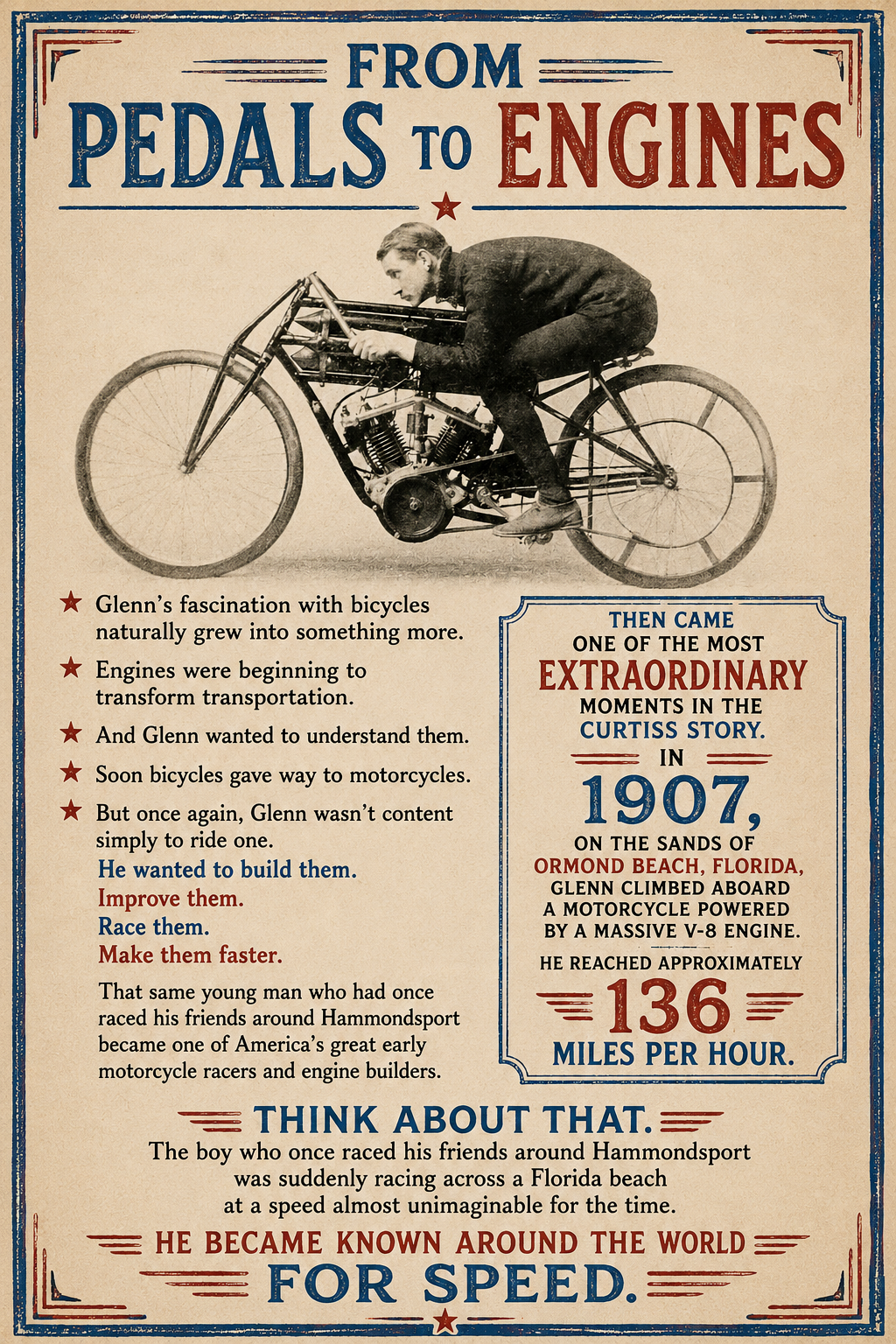
By 1907, Glenn's fascination with engines had taken him somewhere extraordinary.
He had developed a massive V-8 engine.
Eight cylinders.
Enormous power.
And then came a wonderfully Curtiss question:
What could it do?
So Glenn did something that seems almost unbelievable today.
He put it in a motorcycle.
Calling the resulting machine a motorcycle almost feels inadequate.
It looked more like an enormous engine that happened to have two wheels attached to it.
Long.
Mechanical.
Exposed.
Raw.
And astonishingly powerful.
The V-8 represented far more than Glenn's desire to go fast.
It represented years of accumulated knowledge.
From bicycles.
From motorcycles.
From racing.
From manufacturing.
From broken parts.
From overheated engines.
From countless adjustments made back in Hammondsport.
Everything was building toward this moment.
ORMOND BEACH — 1907
Now picture the scene.
A broad Florida beach.
Hard-packed sand stretching into the distance.
The Atlantic beside him.
Glenn climbs aboard his V-8 motorcycle.
Somewhere nearby, Tank watches his old friend prepare.
Tank has seen G.H. race before.
He knows the competitive streak.
He knows the quiet concentration that comes over Glenn when he is studying a machine.
But this is different.
No protective cockpit.
No modern racing suit.
No sophisticated safety equipment.
Just Glenn.
Two wheels.
A tremendously powerful V-8 engine.
And a long stretch of Florida sand.
The engine erupts.
Glenn accelerates.
Faster.
And faster.
The beach begins disappearing beneath him.
Then comes the number that will become part of Curtiss legend:
Approximately 136 miles per hour.
In 1907.
THINK ABOUT THAT FOR A MOMENT
Forget modern highways.
Forget automobiles comfortably traveling 70 miles per hour.
Forget airbags, advanced tires, computerized engineering and modern braking systems.
Picture America in 1907.
Horses still pull wagons through countless American communities.
Many roads remain unpaved.
The automobile itself is still transforming from novelty into practical transportation.
And a young man from a tiny village on Keuka Lake has just hurtled across a Florida beach on two wheels at roughly 136 miles per hour.
The newspapers take notice.
The public takes notice.
The world of speed takes notice.
The quiet Hammondsport bicycle mechanic has become an internationally known motorcycle manufacturer and racer.
And the name Glenn Hammond Curtiss suddenly carries another distinction:
THE FASTEST MAN ON EARTH.
BUT SPEED IS ONLY PART OF THE STORY
For almost anyone else, Ormond Beach might have been the climax.
Imagine accomplishing that much.
A world-renowned speed achievement.
Newspaper headlines.
Recognition.
A permanent place in transportation history.
Glenn could have spent the rest of his career building faster motorcycles.
But Glenn Curtiss was never particularly interested in standing beside yesterday's accomplishment.
Because while everyone else was fascinated by how fast he had gone, Glenn remained fascinated by something else.
The engine.
The power.
The weight.
The efficiency.
And most importantly:
What else could an engine like that do?
That question was about to carry him into an entirely different world.
THE MOTORCYCLE WAS PREPARING HIM TO FLY
The connection between Glenn Curtiss's motorcycle years and his aviation career is one of the most fascinating parts of his story.
Aviation didn't simply appear from nowhere.
There is a mechanical path running directly through Glenn's life.
Bicycle repair taught him precision.
Bicycle racing taught him efficiency.
Motorcycles taught him power.
Manufacturing taught him how to turn an idea into a reliable product.
Engine building taught him the importance of power-to-weight.
Competition taught him to test ideas under extreme conditions.
Mechanical failures taught him to investigate rather than surrender.
And racing taught him something else.
A limit might simply represent the best anyone had figured out—
so far.
That philosophy would become essential in aviation.
Because the men attempting to conquer the air faced a tremendous problem.
They needed power.
But they couldn't afford weight.
An engine that worked beautifully on the ground might be useless in an airplane if it was simply too heavy to lift.
They needed lightweight, powerful, dependable engines.
Back in Hammondsport, Glenn Curtiss had spent years obsessing over almost exactly that problem.
He just happened to be putting those engines on motorcycles.
For now.
FROM TWO WHEELS TO WINGS
Look back at Glenn's journey and suddenly it doesn't seem like a series of unrelated accomplishments.
It looks like a staircase.
A boy repairs bicycles.
Then he races them.
He opens a bicycle shop.
He becomes fascinated with engines.
He motorizes bicycles.
He builds motorcycles.
He designs his own engines.
He establishes a manufacturing company.
He races the machines he builds.
He pushes those engines harder.
He learns to produce greater power with less weight.
He builds a V-8.
He races across Ormond Beach at approximately 136 miles per hour.
And somewhere along the way, people trying to build flying machines begin hearing about the extraordinary lightweight engines coming out of a little village in the Finger Lakes.
Soon, another extraordinary figure would enter the story.
A scientist.
An inventor.
A man whose own name was already known around the world.
Alexander Graham Bell.
Bell wasn't interested in how fast Glenn Curtiss could travel across a beach.
He was interested in something else Glenn possessed.
His knowledge of engines.
Because Bell and a small group of experimenters were trying to solve a problem far more difficult than making a motorcycle go faster.
They wanted to leave the ground.
And the Hammondsport mechanic who had spent years asking how to make engines lighter, stronger and more powerful was about to discover that everything he had learned on two wheels had been preparing him for something much bigger.
The Hammondsport Boys had taught G.H. to compete.
James Smellie's bicycle shop had given his curiosity a workshop.
His own bicycle business taught him independence.
Motorcycle manufacturing taught him how to build.
Racing taught him how to test.
Ormond Beach showed the world what Glenn Curtiss could do.
And now—
the sky was waiting.
COMING NEXT ON THE ROAD TO WINGS & WHEELS™… 🚗
You know Glenn Curtiss raced motorcycles.
You know he became The Fastest Man on Earth.
But did you know G.H. and Lena owned the first automobiles in Hammondsport?
And, of course, Glenn couldn't simply drive a car.
He had to reimagine it.
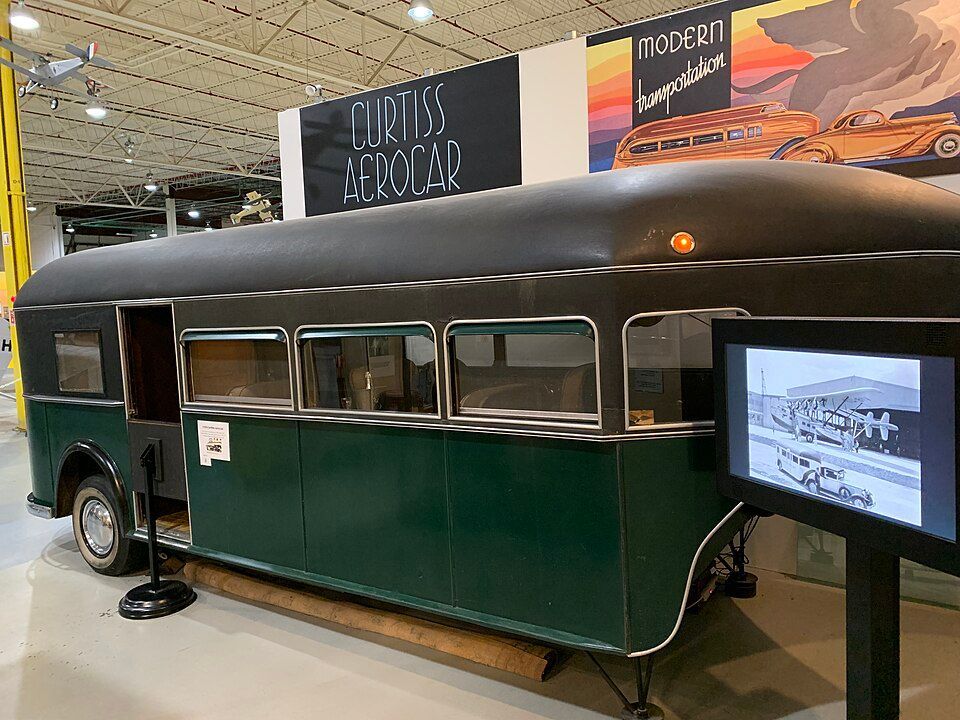
Aircraft engines in automobiles. Streamlined designs. And eventually… a flying car.
Part Three | G.H. AND THE AUTOMOBILE
Four wheels, aviation engines, a flying car—and another machine Glenn Curtiss couldn't resist reimagining.
Coming next from Keuka Roots™.
🏁 THE ROAD LEADS TO HAMMONDSPORT
Every story in our Road to Wings & Wheels series leads us back to the place where so much of it began—Hammondsport, New York, home of Glenn H. Curtiss.
Now it’s your turn to become part of the story.
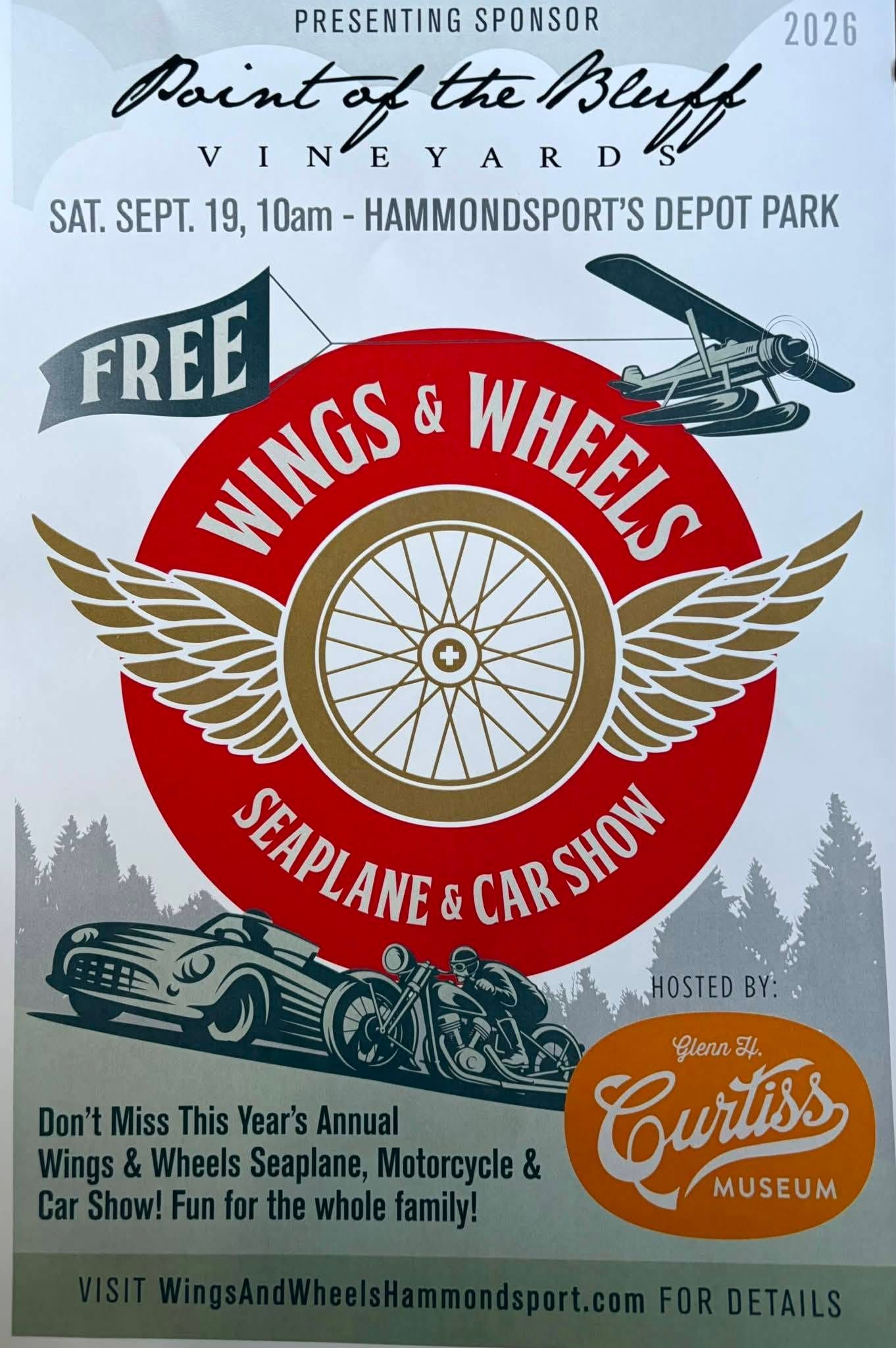
✈️ 🏍️ 🚗 WINGS & WHEELS 2026
Saturday, September 19 | 10 AM–4 PM
Hammondsport, New York
Registration is still open for participants! Bring your seaplane, classic or special-interest car, or motorcycle and join us for a day celebrating the machines, innovation, speed, and spirit that helped put Hammondsport on the map.
Have a ride worth showing off? Enter it today and become part of Wings & Wheels!
Participant information and registration are available through the Glenn H. Curtiss Museum.
And for everyone coming to watch, explore, photograph, reminisce, and enjoy the day—admission is FREE!
So mark your calendar, bring the family, and meet us in Hammondsport as we celebrate the remarkable legacy of Glenn Curtiss and the enduring love of wings, wheels, and everything that moves us.
See you at Wings & Wheels!
Join the Keuka Roots FB Group!
Stay Rooted. Stay Keuka.™